
2 hr 30 min
Historic Dubai Markets & Heritage Quarter Walking Experience
Navigate traditional souks with insider knowledge, savor authentic street eats, and cruise the Creek
Reserve


Hand-picked by our editors — only the best 5 walking experiences from 47 reviewed
Verified partners for every tour, free cancellation where available, and instant confirmation on every booking.
2 hr 30 min
Navigate traditional souks with insider knowledge, savor authentic street eats, and cruise the Creek
Reserve
4 hr
Journey through historic Al Fahidi, cruise Dubai Creek by traditional boat, and explore iconic souks
Reserve
2 hr
Journey through historic Al Fahidi, glide across the creek by traditional boat, and taste authentic Emirati flavors
ReservePrices from verified partners. Availability updates in real time at checkout. Free cancellation policies apply where shown.
The landmarks, rooms, and views travelers on this tour remember — all visible on a single visit.
These historic towers were the world's first natural air conditioning system, channeling breezes into homes to lower indoor temperatures by up to 10 degrees.
Professional tours offer deep narrative context about Dubai Creek landmarks, while self-guided walks provide complete freedom; most visitors find the guided experience more immersive for historical storytelling.
| Feature | Top pick Guided Tour | Self-Guided Tour |
|---|---|---|
Cultural Insight |
Expert historical narration | Visitor-led research |
Navigation Ease |
Professional route management | Map-dependent wayfinding |
Flexibility |
Scheduled itinerary | Fully adjustable timing |
Access to Hidden Gems |
Curated secret spots | Requires prior local knowledge |
Fixed Schedule vs At Your Own Pace |
Fixed group timing | Unlimited personal pace |
Booking Options |
guided old dubai walking tour tours | guided old dubai walking tour tickets |
| See tickets → |
Verdict: Opt for the guided old dubai walking tour tour if you prioritize academic depth and curated narratives, but choose self-guided if you prefer a quiet, spontaneous approach to visiting this Dubai landmark.
Choose your ticket, select your date, and reserve in under two minutes. Secure checkout handled by our verified partner.
Instant confirmation by email, with a mobile voucher you can save offline. No printing, no queuing at a collection desk.
Arrive at the entrance, show your voucher on your phone, and walk in. Most tickets include priority or skip-the-line access.
Practical details for your visit straight from our verified partners — hours, access, rules, and how to get there.
Modest clothing is recommended out of respect for local traditions and heritage sites. Avoid overly revealing attire when entering mosques or cultural centers.
There are no formal security checkpoints for the district, but carry-on bags should be kept manageable. Large luggage is discouraged due to narrow lanes.
Photography is permitted throughout the public alleys. Please respect the privacy of residents and seek permission before taking close-up portraits of locals.
The district features flat, paved pathways making it accessible for visitors using wheelchairs or strollers. Some individual galleries may have minor thresholds.
The area is very family-friendly, offering an educational experience for children to learn about traditional architecture. The open courtyards are safe spaces for walking.
Numerous traditional cafes and restaurants are located within the district. You will find authentic Emirati cuisine and refreshments inside restored wind-tower houses.
Best time to go, insider tips, nearby landmarks, and the cancellation fine print — flip through to skim what matters to you.
Flexible, no hidden fees.
Full refunds are typically provided for bookings cancelled at least 24 hours in advance. Entrance to the historic district remains 0 AED.
Dubai Creek divided the settlement into two trading halves a century before oil changed everything. Dhows from Persia and India still moor along the same wooden piers where merchants once haggled over frankincense and textiles, and the narrow lanes of Al Fahidi Historical Neighbourhood preserve wind-tower houses built from coral stone and gypsum in the early 1900s. The district was slated for demolition in the 1980s until Dubai Municipality recognized its architectural value and converted dozens of courtyard homes into galleries, cafés, and cultural institutes. Today the quarter functions as the city's most accessible archive of pre-oil life. A guided Old Dubai walking tour reveals details invisible to solo wanderers. The barjeel wind towers that crown every major structure were engineered to funnel Gulf breezes downward through internal shafts, cooling rooms by five degrees without electricity. Doorways are deliberately low, designed to force visitors into a bow of respect. Majlis seating areas still face inward toward fountains rather than outward to the street, reflecting Bedouin hospitality codes adapted to merchant life. Guides explain why certain alleys end in blind courtyards, how the falaj irrigation channels once networked the entire neighborhood, and which families commissioned the carved teak doors shipped from Zanzibar. The textile souk on the Deira side operates under the same tin-roofed arcades constructed in the 1950s, where wholesalers sell brocade, silk, and cotton by the bolt. The spice souk remains a working market, not a heritage display—vendors measure saffron threads and dried limes by weight, and the scent of cardamom saturates the air. The abra crossings that link both banks cost one dirham for residents and function as public transport, not tourist spectacle, though every heritage walk includes at least one crossing to connect the souks with the Al Fahidi Quarter. The route typically spans two to three kilometers on foot, with frequent pauses at mosques, heritage houses, and the 1787 Al Shindagha watchtower. Guides contextualize the UNESCO-nominated Creek district within broader Gulf trading history, explaining how this urban fabric differs from the merchant quarters of Sharjah and Muharraq.
"Wind towers funnel Gulf breezes downward through internal shafts, cooling rooms by five degrees without electricity."
A step-by-step walkthrough of the visit — what you'll see, how long each stage takes, and the details that matter.
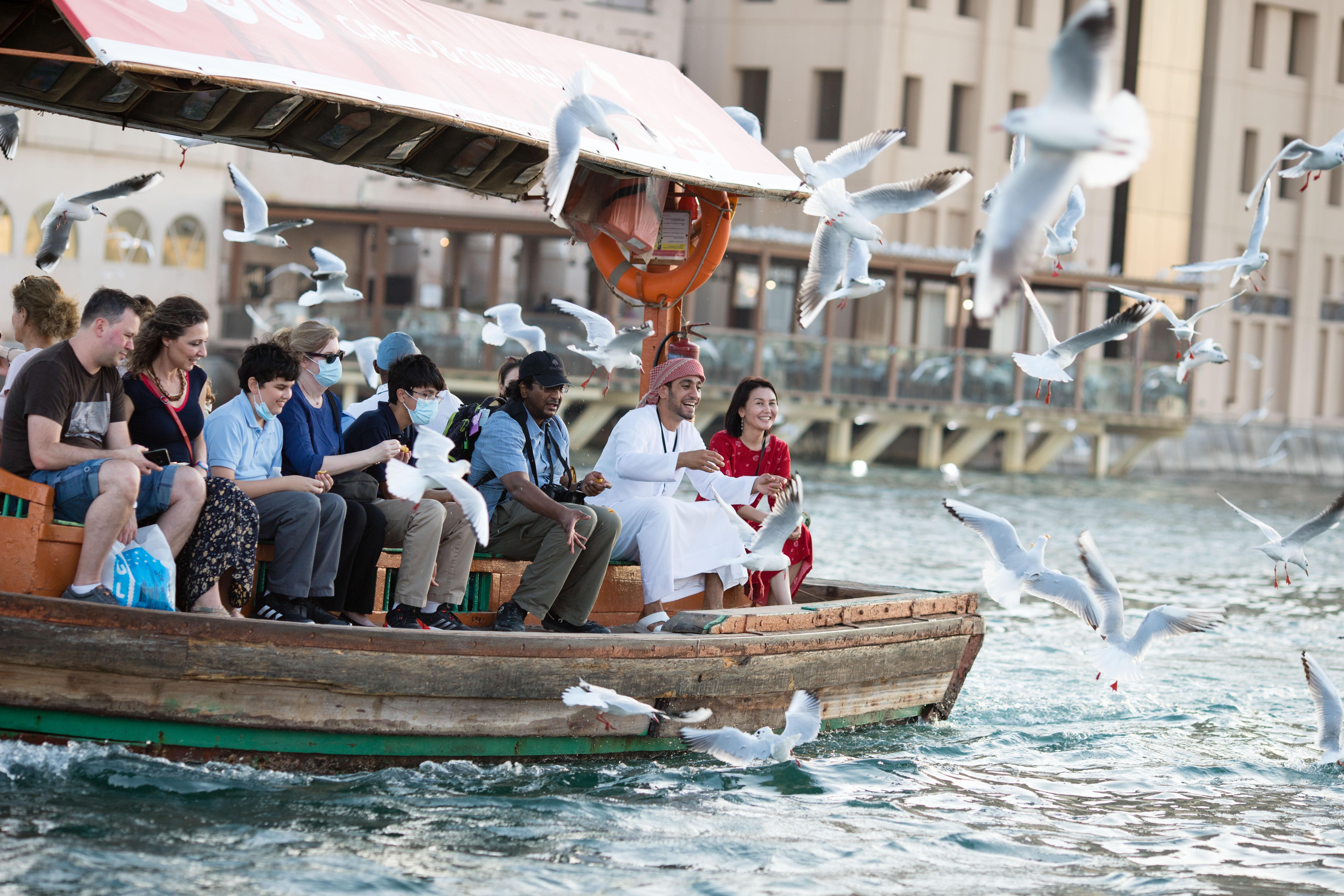
You meet your guide at the Grand Mosque roundabout in Bur Dubai, where the walking route begins along the Creek promenade. The first stop is the Al Fahidi gate, where you step into coral-stone lanes shaded by overhanging wind towers. Your guide points out the low doorways and explains the engineered ventilation system as you enter a restored courtyard house converted into a gallery. You walk through three more heritage buildings, each preserving original majlis seating and carved wooden screens. Midway through the district, you board a wooden abra for the five-minute crossing to Deira. The boat rocks gently as it cuts across the Creek, passing cargo dhows and fishing vessels. On the opposite bank, you enter the textile souk's covered arcades, then continue to the spice market where vendors offer samples of saffron and dried limes. Your guide negotiates a tasting of local street food—luqaimat doughnuts or camel milk ice cream—before circling back to the gold souk's perimeter. The walk concludes at the Al Shindagha watchtower, where you climb the ramparts for a panoramic view of both Creek banks and the distant glass towers of modern Dubai.
A guided old dubai walking tour is a highly recommended way to understand the history of Dubai Creek and the architecture of the Al Fahidi Historical Neighbourhood.
The Al Fahidi Historical Neighbourhood is accessible 24 hours a day, though your guided old dubai walking tour may operate during daylight hours.
The district itself has 0 AED entry, but your guided old dubai walking tour tickets will cover the costs associated with the professional guide and any entry fees to specific private museums.
Most guided old dubai walking tour tours are suitable for all ages, provided participants can walk through the district for the tour duration.
A standard guided old dubai walking tour typically lasts between 1.5 and 3 hours, depending on the specific package chosen.
Yes, you are encouraged to take photos throughout your guided old dubai walking tour, though please respect the privacy of the local residents.
Yes, the Al Fahidi Historical Neighbourhood is family-friendly and well-suited for a guided old dubai walking tour with children.
The best arrival window for your guided old dubai walking tour is 07:00–10:00 to enjoy the cooler temperatures and best lighting.
While there is no strict dress code for the district, modest clothing is appropriate for a guided old dubai walking tour out of respect for local Emirati culture.
Please refer to your specific booking terms, but most operators offer free cancellation up to 24 hours before your scheduled guided old dubai walking tour.